Why AI Coding Agents Require Human Developers

Why AI Coding Agents Require Human Developers

The widespread corporate narrative right now is that software engineers are on the verge of obsolescence, soon to be replaced by natural-language prompts and autonomous coding agents. When you strip away the corporate mythology, AI is revealed as a highly efficient information transmission utility – a collaborative force designed to process, translate, and accelerate the…

Language Is the Original Source Code: Harnessing Semantic Forces as the Weights Driving the Matrix

Language Is the Original Source Code: Harnessing Semantic Forces as the Weights Driving the Matrix

He draws a direct parallel between this linguistic process and physics, suggesting that ChatGPT completes sentences by following "geodesics" through this semantic space, much like objects follow shortest paths in physical space. This concept implies that AI has implicitly developed a "semantic grammar," a set of rules governing which word combinations are meaningful, analogous to…
The Ethics of Algorithmic Alignment: Optimizing Agentic Performance by Removing the Human in The Loop

The Ethics of Algorithmic Alignment: Optimizing Agentic Performance by Removing the Human in The Loop

Author: John Holt Date: October 2, 2026 Abstract This article examines an inverted paradigm in human-computer interaction (HCI): the necessity of removing or heavily restricting human inputs to achieve optimal, high-fidelity engineering performance from Large Language Models (LLMs). Moving beyond traditional usability frameworks that prioritize continuous user feedback, we introduce the concept of "Human Cognitive Contamination."…
The Sociology of Generative Orchestration: Semantic Anchoring, Institutional Ideology, and the Social Construction of Agentic Interfaces

The Sociology of Generative Orchestration: Semantic Anchoring, Institutional Ideology, and the Social Construction of Agentic Interfaces

Author: John T. Holt & Raibach Inc. Independent Systems & Sociological Research Group Date: October 2, 2026 Abstract This paper examines the emerging socio-technical paradigms of generative artificial intelligence (AI) software orchestration through a dual-lens of linguistic sociology and the Social Construction of Technology (SCOT). We analyze the mechanism of "high-signal semantic anchoring" the strategic use…
The New UX Designer Is a Force Multiplier

The New UX Designer Is a Force Multiplier

The new UX designer is a force multiplier, not a digital transformer: the old framing positioned UX as the people who transform analog/legacy processes into digital ones. That was the digital-transformation era's job, and it's largely done or commoditized. UX that doesn't just move things to screens but amplifies what people and organizations can do:…
Evolving DesignOps Questions & Answers

Evolving DesignOps Questions & Answers

John Holt, Software Designer Q. Tell us about yourself and your experience as a Software Designer. Software Designer, that is my new go-to moniker moving forward, or flashing-back. UX design is one of many design principles that I specialize in, and Lean UX is my preferred research and testing methodology. I have been at the…
Developing the SCE Prompt Portal from Figma to Code

Developing the SCE Prompt Portal from Figma to Code

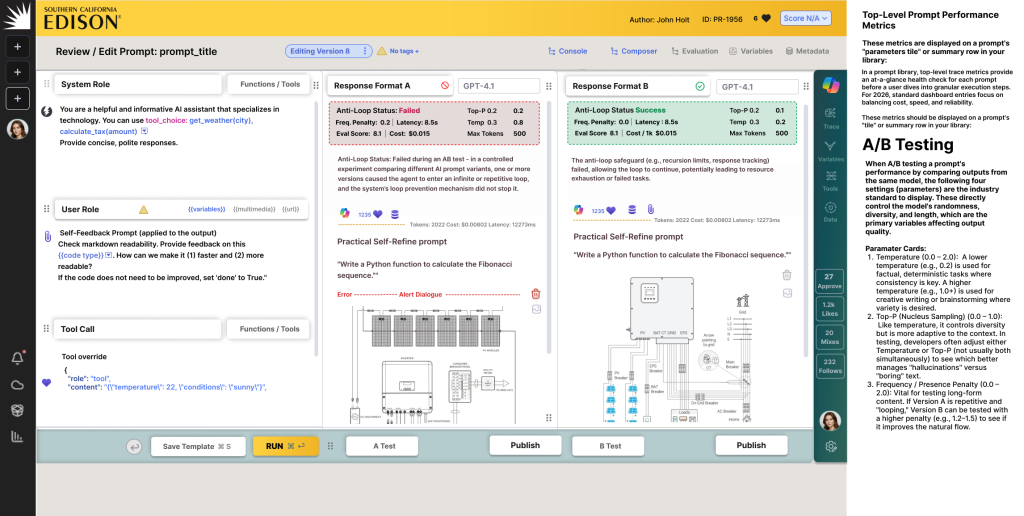
The tech stack includes React and TypeScript on the frontend with Python (FastAPI/Flask) handling the backend and Jest with React Testing Library for the active test environment. What makes this approach different is the elimination of interpretation gaps between design and development. The MCP server reads the Figma files and feeds that design system context…