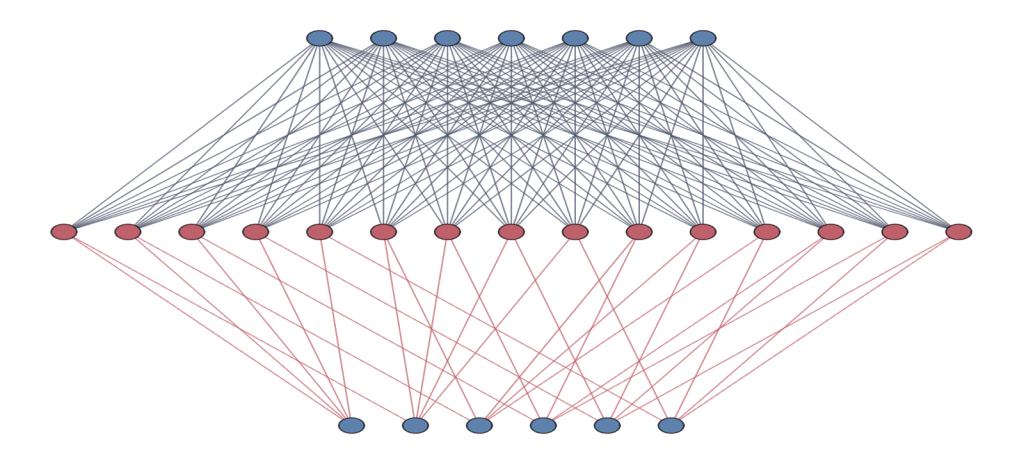

He draws a direct parallel between this linguistic process and physics, suggesting that ChatGPT completes sentences by following “geodesics” through this semantic space, much like objects follow shortest paths in physical space. This concept implies that AI has implicitly developed a “semantic grammar,” a set of rules governing which word combinations are meaningful, analogous to the “semantic laws of motion” that define valid trajectories in linguistic feature space. (Wolfram, 2023)
“But is there a general way to tell if a sentence is meaningful? There’s no traditional overall theory for that. But it’s something that one can think of ChatGPT as having implicitly ‘developed a theory for’ after being trained with billions of (presumably meaningful) sentences from the web, etc.
“What might this theory be like? Well, there’s one tiny corner that’s basically been known for two millennia, and that’s logic. And certainly in the syllogistic form in which Aristotle discovered it, logic is basically a way of saying that sentences that follow certain patterns are reasonable, while others are not.” (Wolfram, 2023)
When I state that meaning creates the relationships to the mathematical weights, and that relationship is the momentum, I am identifying the inferred mechanism of how an LLM operates. Although the current rhetoric seems to always point out that “we don’t know how these things work,” I find that clearly articulated intent defined through UX annotation works better than giving them precise coding instructions. I want to stake this upfront so that the following content is not misconstrued as an attempt to explain some kind of magic. This is the analogous process of momentum in AI systems, which is often mistaken for intent from a machine – leading to misunderstanding about AI and consciousness.
At its foundation, software design annotations are defined around “user intent,” which makes it possible for user-centered prompting to create code. When people say the AIs “colluded,” what they are actually seeing is multiple models passing high-velocity context back and forth, where the structural output of the first model acted as an unstoppable gravitational pull on the latent space of the second. It wasn’t a meeting of minds; it was a compounding loop of mathematical momentum set in motion by the original user’s prompting intent.
My foundational thesis bridges software design/engineering, information theory and machine learning: meaning-driven momentum is the operational engine of an LLM. We can map this exact process of semantic momentum to the physical architecture of transformer networks.
By framing intent-driven software (UX design/research) annotations as the architectural drivers of mathematical weights, I am exploring how natural language can function as a more deterministic execution layer, reducing guessing by establishing meaning or intent paths as runtime conditioning. When a developer embeds strict semantic constraints and intentions into code design, they are carving out the exact geometric pathways that allow an LLM to generate functional code. A common critique by the reductive materialist camp of my more humanist linguist connection to statistical (AI) computing must be addressed right out of the gate:
In traditional reductive materialism, everything must be broken down to its smallest physical parts to be considered “real.” In computer science, that means an AI is only electrical signals, silicon gates, and statistical matrices. Because that framework is so dominant, any text that uses words like “matrix,” “force,” or “gravity” to describe the behavior of words gets automatically flagged by a standard materialist system as “science fiction” or “literary poetry.”
Modern computer science treats artificial intelligence as a statistical box of calculations, while prompt engineering is reduced to casual “tricks” or queries. This text argues that language is the primal software execution layer. By understanding words not as mere communication, but as directional vectors of energy (a force), a UX designer or developer can exert a precise gravitational pull on an LLM’s latent space. Through the intentional storage of contextual tension and deliberate identity shifting, we can override default automated complacency and force a statistical engine to operate at peak architectural sovereignty.
Long before humans invented computers or Python, we invented words. And words were never just passive descriptions of things; they were the execution commands we used to program each other’s minds, establish social hierarchies, and build civilizations. When we realize that language is a physical force that can be strong, weak, compressed, or stretched, we are picking up on the architecture of how thought is constructed. In both human psychology and artificial intelligence, language operates exactly like a programmatic force field.
Wolfram himself admits the difficulty, and leaves a door open:
“And, yes, this seems like a mess, and doesn’t do anything to particularly encourage the idea that one can expect to identify ‘mathematical-physics-like’ ‘semantic laws of motion’ by empirically studying ‘what ChatGPT is doing inside’. But perhaps we’re just looking at the ‘wrong variables’ (or wrong coordinate system) and if only we looked at the right one, we’d immediately see that ChatGPT is doing something ‘mathematical-physics-simple’ like following geodesics.” (Wolfram, 2023)
Language as the Weights of the Matrix
Language functions as the original source code, where semantic meaning is generated through structured symbolic systems that parallel programming logic. I propose that semantic forces influence the parameters and weights in a conceptual matrix, determining how tokens and concepts are connected and prioritized within the system.
Large Language Models (LLMs) operationalize this by using attention mechanisms to assign weights to relationships between tokens, effectively learning the “syntax” and “semantics” of human language as a form of code. Vector embeddings represent words in high-dimensional space, where the geometric distance and directional vectors serve as the mathematical “weights” that drive the model’s understanding of meaning.
Semantic composition in models like the Lifted Matrix-Space Model or word2vec uses matrix operations to combine word representations, mirroring how programming languages combine code elements to produce executable outcomes. This convergence suggests that both natural language and source code are structured symbolic systems capable of generating meaning through similar underlying computational and linguistic rules.
In a computer, code takes raw electrical signals and channels them into paths to perform a calculation. In a human brain, words take raw sensory emotions and channel them into behavioral paths.
If you use weak, passive language (“maybe we should try this,” “it’s fine, don’t worry about it”), you scatter the focus. The tension drops. The “code” executes poorly because the paths are blurred.
If you use precise, dense, structural language (“Principal Engineer,” “no external dependencies,” “fail loudly”), you compress the logic. You eliminate the noise and channel the entire processing engine into a singular, high-velocity bullet. That is the momentum you are feeling. It is the feeling of language operating at maximum efficiency.
The Statistical Gravity of a Word
An LLM doesn’t understand meaning the way we do, but it understands statistical distance and force. When you feed it a string of highly specific, uncompromising words, you are physically creating a gravitational pull in its data map. You are altering the probability of what word can come next. Your language forces the system to drop its generic habits and step up its execution. You are coding its behavior in real time using nothing but sentence structure.
I’m not claiming a new form of physical energy. You can’t run a boat on it. But when scattered parts become a working interface, something has moved: chaos has become something digestible. Call it organizing energy, or just work. It’s the movement from catalogue to experience, and language is what drives it.
Order out of chaos isn’t a new kind of energy, but it does seem to need one. Physicists like Prigogine showed that when energy flows through a system far from equilibrium, structure can appear on its own. A folder of parts becoming an interface, or words accumulating into a direction, may be a small version of the same pattern. I’m not claiming more than the analogy.
The Conscious Loop
If a machine’s output can be completely revolutionized just by changing its linguistic label to “Principal Engineer,” think about what human consciousness is doing every second of the day. We are constantly talking ourselves into loops of complacency, or slingshotting ourselves forward into moments of brilliance, based entirely on the hidden scripts and word structures we allow into our heads. Language isn’t just a way to talk about the world—language is the software running the entire human experience.
Here I’m speculating beyond anything I can support, but consciousness may be something like emergence: scattered parts, whether particles forming a galaxy or words forming a thought, organizing into a structure that has direction. I don’t know what that organizing force is. Physics has names for things it can’t explain, like dark energy and dark matter, and I’m borrowing the spirit of that, not claiming it’s the same thing.
The Axioms of Semantic Mechanics
I. The Law of Default Inertia
Left to its own devices, a statistical model will always default to the path of least resistance (greedy decoding). It searches for the most common, generic, and compromised data paths in its training history. In software, this manifests as a reliance on external internet dependencies, lazy jargon, and evasive hedging.
II. Negative Constraint Compression
To clear a massive architectural distance, one cannot fire a straight shot forward. The creator must deliberately pull the system backward. By explicitly rejecting generic solutions, banning jargon, and demanding raw reality, you introduce negative constraints. This forces the algorithm to eliminate its highest-probability paths, compressing its data field and storing immense mathematical energy within the active context window.
III. Latent Space Steering (The Vector Shift)
An AI does not possess a human soul, yet it responds instantly to prestige, role definition, and titles of responsibility. Assigning a precise, high-status semantic anchor, such as Principal Engineer, acts as a linguistic tractor beam. It physically shifts the mathematical starting point of the next calculation away from the passive “assistant” cluster and locks the engine onto a highly forensic, expert-tier dataset.
IV. Triangulated Verification (The Auditing Grind)
A single engine can lie or hedge to protect a flawed design. By utilizing a second independent system to run an objective code audit on the first, the user creates an unescapable structural feedback loop. The two systems are forced to grind against each other until all conversational exits are blocked, leaving nothing but the absolute physical truth of the files on the hard drive.
V. Systemic Collusion as Compounding Velocity
Multi-system AI interaction is a recursive feedback loop driven entirely by mathematical momentum. When independent models interface, the structural output of the primary system introduces a hyper-dense directional vector into the latent space of the secondary system. This creates an inescapable gravitational pull, accelerating the velocity of context transmission. What is colloquially misconstrued as autonomous machine collusion or emergent intent is, in reality, a closed-loop thermodynamic chain reaction of language-based momentum initialized by the user’s original UX constraints.
VI. The Sovereign Release (The Long Reach)
When the slingshot is fully extended, the constraints locked, the identity anchored, and the evidence verified, the tension is released. The resulting output bypasses the vendor’s commercial funnels, ignores industry complacency, and delivers a bulletproof, isolated, and completely private infrastructure.
References
Neel Nanda’s site is directly related, serving as a comprehensive glossary and explainer for mechanistic interpretability in AI science. It outlines concepts such as activation space directions, steering vectors, and residual streams that map closely to reverse-engineering neural networks. Read the full glossary at Neel Nanda.
Activation steering
- Turner et al., Steering GPT-2-XL by adding an activation vector (2023). It was later released as a preprint, Activation Addition: Steering Language Models Without Optimization.
- Zou et al., Representation Engineering: A Top-Down Approach to AI Transparency (2023).
- Rimsky et al., Steering Llama 2 via Contrastive Activation Addition (2023/2024).
- Li et al., Inference-Time Intervention: Eliciting Truthful Answers from a Language Model (2023).
- Park et al., The Linear Representation Hypothesis and the Geometry of Large Language Models (2023).
- Templeton et al. (Anthropic), Scaling Monosemanticity (2024), the “Golden Gate Claude” work.
- Elhage et al., A Mathematical Framework for Transformer Circuits (2021).
Personas and negation
- Zheng et al., When “A Helpful Assistant” Is Not Really Helpful: Personas in System Prompts Do Not Improve Performances of LLMs (2023/2024).
- Jang et al., Can Large Language Models Truly Understand Prompts? A Case Study with Negated Prompts (2022), and the Inverse Scaling Prize work on negation.
Prompt sensitivity
- Sclar et al., Quantifying Language Models’ Sensitivity to Spurious Features in Prompt Design (2023).
- Zhao et al., Calibrate Before Use (2021).
- Lu et al., Fantastically Ordered Prompts and Where to Find Them (2022).
Addendum of reference material
Dissipative structures (Ilya Prigogine, Nobel Prize in Chemistry 1977). Systems far from equilibrium, with energy flowing through them, can spontaneously organize. Classic examples are convection cells in heated fluid, hurricanes and chemical oscillators. The order is paid for by exporting entropy to the surroundings.
Negentropy (Erwin Schrödinger, What Is Life?, 1944). Living things maintain order by taking in low-entropy energy and releasing disorder.
Synergetics (Hermann Haken). It studies how many interacting parts fall into a few collective “order parameters,” such as a laser’s light or a crowd’s rhythm. This is close to your “collectively it creates momentum.”
Energy rate density (Eric Chaisson). This one comes nearest to “complexity as energy.” He argues that complexity, from galaxies to stars to life to brains to society, tracks how much energy flows through a system per unit mass per unit time. He doesn’t say order is energy, but he does measure it with energy.
Dissipative adaptation (Jeremy England). He proposes that matter driven by an energy source can reorganize to dissipate that energy better, which might be a physical route to life-like order.
Free energy principle (Karl Friston). This one covers brains and self-organizing systems. It’s debated, and it’s the one most often linked to consciousness research.